Cross-posted on Wondering Fair

What does it mean to worship? And where to do it?

For us the activity of worship has become a private affair. Even some agnostics don’t seem to mind that people go about their Sunday mornings engaged in acts of worship, as it occurs comfortably behind closed doors. Occasionally religion spills out into the public space as, in the example of some Christians who fight to keep public monuments of religious significance (the ten commandments, or statues of the cross) in the public space (a courthouse, city center, etc.) in America, or Muslims women who strive to wear the burqa in France. We tend to agree with this relegation of the religious to the private sphere, and often acknowledge it in practice, going about our daily work with only perhaps a furtive prayer or generic expression of virtue, but nothing so peculiar as to strike a secular co-worker as an explicitly religious expression.

burka woman

This division of life into two spheres – public and private – and the further relegation of the religious life to the private sphere has roots in various thinkers and writers across the modern period, but this is a division that is ultimately incompatible from a Christian point of view. Christian worship is, as one theologian (Bernd Wannenwetsch of Oxford University) has recently put it, a Political act: to acknowledge God as the one creator and ruler over everything relativizes every human form of government, and has profound ethical implications in every sphere of life. This fact was perhaps more obvious in the early church as there was a well-worn precedent for “private” religious worship. Rome was relatively tolerant of religious diversity in its empire, provided that worship was relegated to the private space. As long as one’s personal religion remained private, the public space was open for some occasional deference to imperial religion and the state gods which was required for citizenship.

What was remarkable about early Christians is that they refused what was an otherwise comfortable settlement for many other cults of the day. They recognized that the sort of worship that their relationship with the Creator invited them to participate in was wholly encompassing, and as a result, as Wannenwesch puts it, “martyrdom was inevitable, since the ekklesia [church or ‘Christian community’] was bound from the beginning to celebrate ‘political worship’. (148)” Their worship of Jesus blocked their worship of the emperor and the gods, and martyred they were.

There is a sense in which contemporary Christian worship today does not always express the fullness of this reality, but at some point it becomes inevitable. The God we celebrate as being incarnate in the person of Jesus Christ, does not desire a convenient sort of settled relationship, the sort of tepid hug you share with a distant acquaintance. Rather, we are invited into a relationship best represented by a full-on embrace. We are given the gift of life with all its fullness, and this gift is best affirmed by a whole-hearted worship which does not fail to shape all the other dimensions of our lives, private and public. Christian faith transgresses and subverts these boundaries, and invites us away from lifestyles of fragmentation to a daily experience of wholeness.

Jeremy Kidwell

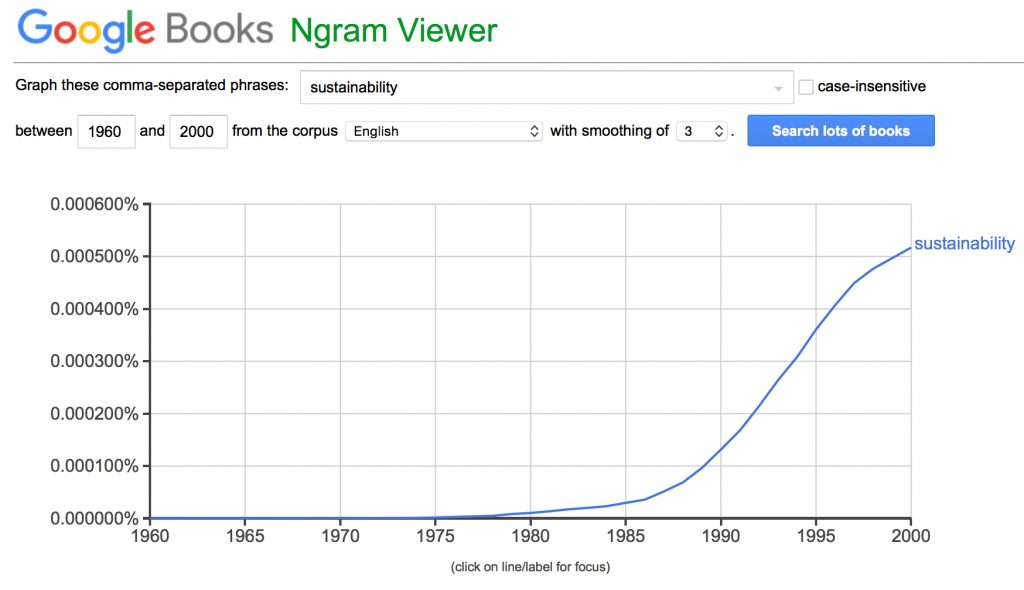
Have you ever had the sense that some term or word which we take for granted might have come into popular use very recently? Or perhaps you wonder if popular usage of some descriptor might have waxed and waned over time? If you’d looking for a quick way to visualise this as data, check out Google’s NGram viewer. If you haven’t already spent time using google books, then I’d recommend you start there. They’ve become a digitizing juggernaut, sometimes in cooperation with University libraries in an effort to create what they describe as “the world’s most comprehensive index of full-text books.” And honestly, they’re probably right.

Having millions of digitized books available is an absolute dream for big data folks such as myself, and Google has been accommodating to people wanting to run research on the database. This can be quite sophisticated, but you can also use NGram viewer for more basic searches. Head on over to the site to check it out for yourself: https://books.google.com/ngrams. There are a few basic functions – you can narrow the search field (which defaults to 1800-2000) and specify the language. You can also run comparative searches on several words, just separate them with commas. Give it a whirl – and let me know in the comments what strange discoveries you make!

I tried a quick search on the much contested term “sustainability” and confirmed that it is indeed a word that no one really bothered using before 1980. There you go.

sustainability

If you want to go really wild, Google makes all their data available through an API. I have in mind to spend some more time working with this tool on my next project which will look at the early (pre-1920) history of environmentalism in Britain and America. Stay tuned for more charts!

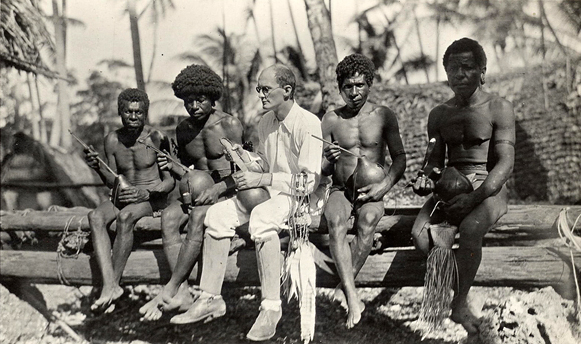
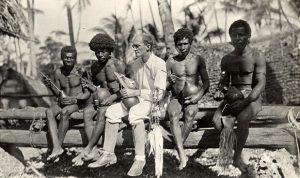
Photo of Bronisław Malinowski, feeling frustrated that the batteries on his smartphone died three months ago.
Bronisław Malinowski feeling frustrated the batteries on his smartphone died three months ago.

Over the past three years, I’ve been moonlighting as a social scientist doing ethnographic fieldwork in communities across Scotland from Callander to Orkney. Before heading out for the first time, I spent a few weeks assembling a toolkit for digital ethnography which I’ve been revising along the way. I thought I’d share a bit about what I’ve settled on using in case others are looking to upgrade their fieldwork toolkit. First, some caveats – I run Apple hardware but am passionate about Free and Open Source Software (FOSS) particularly because it is often cross-platform, so when I switch to linux for my work PC in a couple years, I’ll be able to run most of those tools without much trouble. So my goal was to avoid being proprietary and only go with what was strictly necessary. Here’s what I found: Continue reading

I wrote my undergraduate thesis (back when 30k words seemed like a big deal!) in Microsoft Word. No, I’m not one of those default Microsoft haters – one of the original developers of MS Word is a close friend of mine – it’s a decent product that was a superior option in the early days. However, for a professional writer, Word just has way too much going on. When I’m writing, I’m already really susceptible to distractions and it takes a lot of willpower to stay the course and put words down on paper. I’m not a typesetter – I don’t need to set weird margins, add tab stops, adjust page width, change line spacing, or use a bunch of different fonts. Also, I can’t lug a laptop around everywhere with me, sometimes I think of the perfect sentence to add to my last paragraph while I’m on the bus home and only have a smartphone. So, I went shopping for a new tool a few years ago.

Continue reading

I’ve always had an appreciation for tools. Because I grew up in Seattle in the 1980-90s, quite a lot of my tool-loving energy was spent playing in a digital space while listening to Pearl Jam and Soundgarden. I wrote my first BASIC code when I was 9, built a PC from harvested parts when I was 11, taught myself C programming when I was 13, and installed the first Linux Kernel (1.0) on my own homebrew 386 PC in 1994. All this tinkering and my proximity to the new headquarters of high tech – the Microsoft headquarters was three miles away from my childhood home (all those dot.com millionaires totally ruined our forests with their McMansions) – led to some unusual opportunities. Because Unix experience was still pretty unusual, I was recruited as a teenager to run the email server for our School District. I did PC and network repair on the side, hung out on a lot of IRC channels, tried my best to repel hackers (my teenage friends) and learned quite a lot about computer networks by the time I was ready to head off to college. For a variety of reasons, I took degrees in Music and Literature and kept my IT work strictly professional through a campus maintaining our network infrastructure. After all that time spent in virtual worlds, it felt good to work with my hands – installing ethernet switches, terminating fiber optic cables, and crimping phone wire in strange closets across campus – including a fallout shelter and a bell-tower. At this point google was still ugly, myspace was cool, and the digital humanities weren’t really on anyone’s radar. I took a break from academic study to support my wife while she worked on postgraduate study and took up a series of different jobs at a telecommunications start-up in upstate New York.

Fast forward about 10 years to the present day: now I’m a lecturer in the School of Philosophy, Theology & Religion. My research and publications are in religious ethics – on issues of technology, design and the environment. I still love tools, and things are a lot more exciting in the digital space. But in my experience, academics in the humanities are just too busy to stay on top of the technology, and frankly there are a lot of alluring time wasters out there clamouring for attention.

I’ve started this blog in order to share some of the digital tools and techniques I’ve been collecting over the years. I have strong opinions about what makes a good tool and I won’t mince words on this blog. I hope you’ll feel free to pitch in and share from your own experience. I see digital technologies as a promising way of delivering more innovative research and teaching in higher education, but I also see a lot of people in higher education wasting a lot of time and money which could be devoted towards improving our offerings on many levels. This perspective sets my main criteria for a tool: it must make something better, whether research goal or learning objective, without wasting extra time.

Cross-posted on Wondering Fair

I’m an unrepentant lover of good food. There is nothing better than a pungent combination of spices and the beautiful color of fresh produce to enliven the senses and transport you away from a busy stressful day. More recently, I’ve taken this appreciation to the next level, cooking meals from scratch for guests, and I’ve found that it can be quite fun to make a full day of it. This usually starts with a morning cup of coffee, reading through cookbooks while trying to think of how best to accommodate the tastes of my guests. Then I walk up the hill to pull together as many of the ingredients as I can for the meal at a Saturday farmer’s market. In years past, we’ve enjoyed growing our own ingredients fresh in a garden, taking advantage of the opportunity to grow vegetables that are cheaper, tastier, more fun, and far more socially responsible. For larger meals my wife and I have also discovered that it can be quite fun to plan out seating arrangements, placing complementary personalities next to one another and bringing together friends that we know will enjoy one another’s company. This all culminates, of course, in the meal itself, and I can recall several that stick in my mind as a transcendent moment of bliss. Just the right combination of people, place, conversation, and flavors, can really create a permanently lasting memory.

babette feast

All of this experience flows into my appreciation of the practice of hospitality, which can be as enlivening and satisfying for hosts as it is for guests. But one element of hospitality is a challenge to get used to: its gratuitous nature. I come from frugal roots, and the idea of buying the more expensive of several options (i.e. better ingredients) much less being “extravagant” runs against my nature.

Of great help for me in getting over these less hospitable reflexes was the Danish film, “Babette’s Feast,” based on the story by Isak Dinesen. In it, Babette, a French refugee (and as we come to discover later – a gourmet French chef) arrives in a small Dutch Protestant community looking to escape the revolutionary violence in France and find work as a housekeeper. Some years later she wins the lottery, and much to the surprise of her employers, rather than return home with the money, she asks if she can cook them – now her closest friends – a “real French dinner.” Concerned as Babette returns with a wide variety of exotic and expensive ingredients that an endorsement of such luxury will be unrighteous, the sisters agree with the other invited guests that they will take no pleasure in the meal.

Yet one surprise guest, a general from the Queen’s court, is unaware of their plans and cannot restrain his delight over the course of the meal. His enthusiasm for the banquet is so eloquent that by dessert the meal becomes the site of a remarkable transformation. Long-held resentments and arguments among the diners begin to dissolve and former enemies make peace as their dining experience elevates everyone. These Dutch protestants are reminded that Jesus was the ultimate lover of gratuitous hospitality over good food. A blissful meal serves as a reminder that he extends the ultimate invitation.

In fact, my favourite of Jesus’ meals happens after he is resurrected from the dead. The disciples are heartbroken upon Jesus’ death, and they go out fishing together. After a fruitless night of fishing, Jesus stands on the beach and shouts for them to try fishing on the other side of the boat. They are so overwhelmed with the net now full of  fish that Peter jumps into the sea and swims ashore, while the others gather the fish and paddle the boat back in. When they land, they find that Jesus has already prepared a place for them to have a meal together, and they have breakfast together (John 21:15).

I’m particularly fond of preparing breakfast for guests, and so I can appreciate all the attention that went into Jesus’ greeting of Peter and the other disciples. He gathered driftwood to make a fire to cook the fish (which he knew would be on the way), brought fresh bread as a side, and perhaps rolled up some logs, or laid out blankets for them all to sit on. He prepared a space, and then invited them to eat with him.

Jesus’ breakfast, though simple, is as gratuitous as Babette’s feast. He may have dazzled his guests with a net full of fish rather than with the intricacies of French cooking, yet his’ is also a free hospitality. His meal around a charcoal fire was rustic and unadorned, but it was gratuitous nonetheless. And it is here that the challenge of hospitality arrives bigger for the guests than for the hosts, because this gift is freely offered, yet must be received.

Cross-posted on Wondering Fair

In one of my favorite books, The Beloved Community, Charles Marsh examines the spirituality of the American civil rights movement. He suggests in particular that a simple notion of just being still (or hanging out) was a crucial part of the heart of the movement. An extended passage is worth quoting:

Nonetheless, the incarnational ethic also encouraged student volunteers and SNCC staff members simply to be present with each other and with the poor. Being a ‘revolutionary,’ somebody once said during a staff meeting, meant learning how to act out of the deepest silence. As an enfleshened church, SNCC displayed a remarkable capacity to anchor itself in particular neighbourhoods and accommodate its disciplines to local needs. Yet as a “free-floating monastic community,” SNCC also made time for reverie and solitude and for rituals that were refreshingly unproductive. A certain kind of contemplative discipline was an important predisposition in building community and enabling trust.

This is an important but often overlooked point. It is easy to forget that so much of a civil rights life involved sitting around freedom houses, community centres, and front porches with no immediate plan of action. The discipline of waiting required uncommon patience even as it sustained humility and perspective, resisting the cultural paradigm of efficiency. SNCC’s genius was its ability to demonstrate to black southerners the strategies available to social progress within an unhurried and sometimes languorous emotional environment. As such, a condition for achieving beloved community was a certain kind of stillness in a nation of frenetic activity and noisy distractions, learning to move at a different pace.

(Charles Marsh, Beloved Community, 92-93)

As I’m daily confronted by social issues and acutely feel their urgency, my inactivity often feels supremely unrighteous. Crises swirl around human society like swarms of flies, and I often assume that we must respond with equally frenzied activism. But as Marsh and reminds us, my intuition has been trained by approaches which see the world through action-filtering glasses. Urgent actions abound, yet exhortations towards stillness and silence are rare: “Be still before the LORD, and wait patiently for him; do not fret over those who prosper in their way, over those who carry out evil devices.” (Ps 37:7).

As Ben pointed out in another Wondering Fair article, this spirituality is also connected with Jesus’ apparent disconnection from ordinary time. The gospel narratives often leave out domestic details, and offer instead a distillation of Jesus’ dramatic words and actions. However, it is worth remembering that these words are often spoken in very ordinary contexts: sitting on a hill eating with some friends (Matthew 5, 14:15), visiting a friend’s house (Matt 8:14; 17:25; Mark 1:29; 2:1; 3:20; 9:33), grocery shopping (John 4:8), getting a drink of water (John 4:7). This is hardly the sort of fast-paced regime-toppling action that would impress a contemporary activist or Hollywood filmmaker.

Along with Ben, I want to suggest that it is in moments of silence and prayer that we find the opportunity to be changed; to pray, confess, and repent. Further, it is in extended ordinary moments shared with our neighbours, as Marsh suggests, that we can experience and express a different kind of deeper, inefficient, serene love.

Jeremy Kidwell

“It is pertinent to see that in a world of becoming this or that force-field can go through a long period of relative equilibrium, or even gradual progression as defined by standards extrapolated from that equilibrium. Much of social thought and political theory takes such periods as the base from which to define time and progress themselves, making the practitioners all the more disoriented when a surprising turn occurs, that is, when a period of intense disequilibrium issues in a new plateau that scrambles the old sense of progress and regress in this or that way. There may be long chrono-periods of relative stabilization in several zones that matter to human participants, but during a time of accelerated disequilibrium the ethico-politics of judgment through extrapolation from the recent past to the medium or distant future becomes rattled or breaks down. It is now time to modify old extrapolations of possibility and desirability. During such periods Kantian and neoKantian ideas of the universal are retrospectively shown to have been filled with more material from a historically specific mode of common sense than their carriers had imagined. The Augustinian-Kantian sense that human beings are unique agents in the world, while the rest of the world must be comprehended through non-agentic patterns of causality, may turn out to be one of them. To the extent this idea takes hold, established notions of the human science and morality become ripe candidates for reconstitution.”

WE Connolly, A World of Becoming (Duke UP, 2010), 150.

I devoted some time these past six weeks to helping organise a people’s climate march in Edinburgh. Given our research focus on how Christians and faith communities mobilise for action around climate change and other related ecological issues, this probably doesn’t come as a surprise. What did surprise many people, myself included, was the extent of the march (pictures here) that occurred last Sunday (21 Sep 2014). We had hoped for 200-300 and by most estimates, we had nearly 3000 people marching through the streets of Edinburgh committing themselves to action and calling on our nation’s leaders here in Scotland to address climate change in substantial ways. I gave a short speech to those gathered before we set off to march, and I offer the text of my speech here:

It’s great to see so many of you here! I’m really excited to see such a huge crowd here today – and our march and gathering here is a big part of an even bigger gathering that is going on today across the world. People’s Climate Marches are happening in over 1500 cities today, with over 2 million people marching. The UN meets this week for a global summit on climate change. This is the first of three summits, and we’re going to be marching in Edinburgh and across the world at all of them. We are here today because we all know that we have a problem. The consequences of climate change are now impossible to ignore, as human activity has pushed the atmospheric concentration of CO2 way past the danger zone of 350 parts per million. Atmosphere may be invisible, but climate change is not. Boats are sailing through the arctic in the summer now, and our weather has become chaotic and dangerous, as so many people in Britain experienced with flooding last year, and that was just a preview – island nations which have been subjected to a relentless barrage of superstorms – have begged the rest of the world to join them in taking action to avoid catastrophic climate change. Though we often talk about the big problems surrounding climate change, it isn’t just about big things, though the loss of public health and safety is a key concern. As our climate changes we grieve the loss of familiar and small things as well; birds, butterflies and frogs are disappearing at an alarming rate. My son Noah loves frogs, and as I see the world through his eyes with wonderment each day, I think, we have to stop this madness. We have to address climate change for his future. You see, I’m here today, not because of fear, but because of love. That great commandment to love your neighbour as yourself compels me to stop climate change for Noah’s future, for all the people who live in vulnerable areas, for the beautiful creatures and landscapes which are a gift entrusted to all of us. I’m here today because of love. So why haven’t we solved climate change? It isn’t invisble, and as Aaron will share with you in a few moments, we’ve known about it for decades. Our civilization has accomplished many astonishing things: we’ve eradicated polio and written the magna carta. But there are lobbyists who are working hard on behalf of fossil fuel companies to obstruct change because they stand to lose a lot of money. So even though our best scientists have helped heighten our awareness of climate change and our most skilled diplomats and policy makers are about to meet in the UN, this march, and all the other marches across the world are absolutely crucial. This march today demonstrates the strengthening of a movement, here in Edinburgh and across the world as we all join in marching to show our concern and solidarity on this issue. This movement is one which will provide us with a new opportunity to show our best side: to show our innovation on clean energy, to reclaim the beauty and joy of living simply, to remember the fun that comes when a whole city comes together. That is what we are starting here today, and this isn’t the end – we’re going to have a bigger march in nine months in December before the UN Climate Change conference in Lima, and even bigger again before the conference in Paris in 2015. We are all here today because we know that we are the solution to the problem of climate change. Marching today is just the start, as we will go home to organise and mobilise: join a group, start a group, speak to our neighbours, write letters, start a book club, write to and visit our MP’s, etc etc etc. Our standing here together shows our commitment to building a new society and it is a privilege for me to stand here with you today as we march through the centre of our Nation’s capitol.

Cross-posted on Wondering Fair

Not long ago, Stanley Fish (professor of Humanities at Florida International University and public intellectual) took an opportunity to respond to critics who thought that a recent Coen brothers’ film, “True Grit,” “was dull and uninspiring.” In a reflection titled, “Narrative and the Grace of God” he defends the more muted narrative in this film, which lacks some of the flash or melodrama that moviegoers might wish for. Fish comments:

That’s right; there is an evenness to the new movie’s treatment of its events that frustrates Gagliasso’s desire for something climactic and defining. In the movie Gagliasso wanted to see — in fact the original “True Grit” — we are told something about the nature of heroism and virtue and the relationship between the two. In the movie we have just been gifted with, there is no relationship between the two; heroism, of a physical kind, is displayed by almost everyone, “good” and “bad” alike, and the universe seems at best indifferent, and at worst hostile, to its exercise.

Turning to the book which inspired both the original film (starring John Wayne), and its recent remake, Fish sketches a discussion of grace and meaning, and he notes,

There are no easy homiletics here, no direct line drawing from the way things seem to have turned out to the way they ultimately are. While worldly outcomes and the universe’s moral structure no doubt come together in the perspective of eternity, in the eyes of mortals they are entirely disjunct… In the novel and in the Coens’ film it is always like that: things happen, usually bad things (people are hanged, robbed, cheated, shot, knifed, bashed over the head and bitten by snakes), but they don’t have any meaning, except the meaning that you had better not expect much in this life because the brute irrationality of it all is always waiting to smack you in the face.

Fish’s comments on heroism, grasped from the teeth of the absurdity, are certainly not new. If anything, he represents one of the best versions of a long conversation in modern nihilism which includes Heidegger, Nietzsche, and Camus. The thinking goes: In this world, filled with strife, heroism is not to be pursued in the context of one’s contingency as a creature made by God, but rather in a radical rejection of theological structures of meaning. One should accept instead that this world is filled with absurdity. The true hero accepts this, forges his or her own way, and creates meaning in the midst of the chaos which threatens to overwhelm human society.

While one can appreciate threads that run through this way of thinking – the honesty to not accept the naïve optimism of a secular humanism that grasps at a religious faith emptied of meaning, the affirmation of the wholeness and physical integrity of persons in the midst of adversity, and a recognition that the sublime lies just under the surface of our ordinary experience – one must also note that these are intricately tied to nihilistic understandings of the world and the heroic paradigm that accompanies it (other contemporary examples might be, Fight Club, The Quiet Man, and American Beauty, perhaps). In a world without meaning, we must accept what we find, and make the most of it.

But this is not the only, or even the most obvious, way to read the world. If we sense that there is meaning to be found in human relationships, then it may be more sensible to affirm that this is because we are created, and that this world, though occasionally baffling, is not absurd, but beautiful, and filled with life and intentionality. Situations of violence, cruelty, and strife do not stand out as the norm, but rather stand out in such sharp relied because they contrast what we expect of the ordered regularity of creation. Human violence and injustice appal us not because we are naïve, but because it goes against the grain of the created universe. The world seems absurd if we try to narrate its movements without God, or worse still with a distorted image of who God is.

Jeremy Kidwell