

I brought Noah home today. The funeral directors had assured me that we had all the time we wanted to sort out the final details, so we took our time choosing a box for Noah’s ashes. It’s wooden carved with vines and leaves with his name engraved on the side. I think the carvings as a helpful reminder of Noah’s love of sitting outside and soaking up the ambiance. I brought our box to the funeral director’s office and they took it into a back room. As I sat on the squeaky leather couches in their waiting area, my imagination pictured a woman walking into a back room with dozens of shelves stretching to the ceiling all full of boxes of ashes, some never to be claimed, others belonging to families like ours who hovered waiting for the right moment and struggling to grasp how such a thing would ever be, and then finally just making a pilgrimage out. And then the kind faced woman who had greeted me brought Noah’s box back out with a gentle smile and that was that. The box was simply heavier than before. I carried Noah’s box to the car and set it on the passenger seat. For a moment I pondered whether to resist the uncanny compulsion to strap in the seatbelt for him.
And there it was, a sense of his presence. Ambiguous, intermittent, shuttling between overpowering and obscured by my own ambivalence about it. I drove Noah home with me, listening to a playlist I’ve made that reminds me of him and helps me to bring the sense of loss to the foreground and I wept as I drove him through Newtown on the way home. He and I had done that drive so many dozens of times just the two of us returning from his favourite board game shop in Welshpool or a cafe, Noah sitting in the front passenger seat beside me with his legs crossed, feet rubbing dirt on the dashboard, ipad perched on his lap, chatting actively with me about whatever was on his mind. The presence carried with me into the house and I brought Noah back up to his bedroom.
One of the major challenges of grief and bereavement is finding ways to navigate the problem of presence.
When my father died, I never really had opportunities or openings to find him with me after he died. My Christianity had instructed me decisively that he was gone, inaccessible to me and either in some other place, or simply in the mind of God waiting until we can all be re-materialised when our bodies were resurrected when the veil between this world and the next one is suddenly parted. In that Christian world, I was tutored in a work of grief that involved reconciling myself to the fact that he was wholly gone. I’ve later learned that this view of “healthy” grief as “moving on” is a major theme in psychoanalysis. Obviously less about the departed being held in the mind of God, but rater than holding on to people we’ve lost and refusing to let them go was seen as a major engine for psychosis by Freud. I’m not sure what Freud would make of my observation that he seems to be party to Protestant iconoclasm.
To be fair to my protestant forebears, brokering access to one’s departed relatives, narratives about spectral journeying and near-death experiences has been a site for heartbreaking levels of fraud and a form of cruelty that people in the 15th century and the 20th century have had to navigate. But, let’s just bracket our anger with Christian and spiritualist hucksters and the brokerage of the saints for a moment, I’ll return to that in a bit.
I remember when I went to University in the late 1990s and discovered – as an English literature major – Neo-gothic literature by Christian authors like Charles Williams who entirely took for granted the persistent presence of friends and relatives who’d died as a basic and reasonable kind of problem. These ghosts had their own problems in Williams’ stories and I took this as a heartening way of embracing the fact that we are always creatures on a journey, trying to become the best versions of ourselves. Jacques Le Goff in his book The Birth of Purgatory argues that Medieval Christians (who were completely obsessed with purgatory) conceived of purgatory as “the system of solidarity between the living and the dead instituted an unending circular flow, a full circuit of reciprocity” (357).
This increasing curiosity about the breadth and diversity of Christian theologies of death followed me to seminary and PhD study. I found a long history of reflection within Christian literature around the meaning of the communion of the saints. And ultimately, I’ve had to accept that the modern protestant view I grew up in is a minority tradition. And that tradition is hardly as innocent as it’s apologists tend to frame it, Reformers pursued violent regimes of iconoclasm and doctrinal reform as a mode of power politics. And that project of reform was aware but indifferent to the ways that it created novels types of estrangement for ordinary people like me who are just wondering if it’s ok to try and talk to your dead father and son.
A major part of my post-doctoral research related to a project my PhD supervisor and I created which we called Ancestral Time. Many environmental scholars have pointed to the importance of ancestral traditions in many indigenous religions in forming people to care for land and place as part of a long chain of responsibility to the land. There is variety in those traditions as to whether ones ancestors are more metaphor, caught up in chains of memory, or actual presence. And here Christianity has affinities with many world religions which are also grappling with this problem, as Le Goff implies in the quote I’ve included above. For our project, we wondered whether Christianity might have analogues in reckoning with the presence of ancestors for our contemporary environmental ethics. As part of the background research I conducted for the project I found works like Robert Pogue Harrison’s *Dominion of the Dead*, Patrick Geary’s *Living with the dead in the Middle Ages* and Carlos M. N. Eire’s War Against the Idols. Doing research on that project finalised a shift which had long been underway to reckon with the presence of the dead as a serious part of everyday life. But I also had to reckon with the ways that everyday people were largely cut off from or indifferent towards these rich Christian traditions. Contemporary people are intensely presentist, and while I was keen to show the resources that Christianity might have to offer for reconnecting our moral lives to the past they weren’t really interested in those traditions.
It’s one thing to take an intellectual position and another entirely to shift your everyday reckoning by developing new rituals and habits. I haven’t really been pressed to make good on these new commitments until the last year. And now it’s a constant question that haunts me – in those moments when grief overtakes me and banishes whatever other things I was working on, I find myself repeating the question, “Noah, where are you? Are you here?”
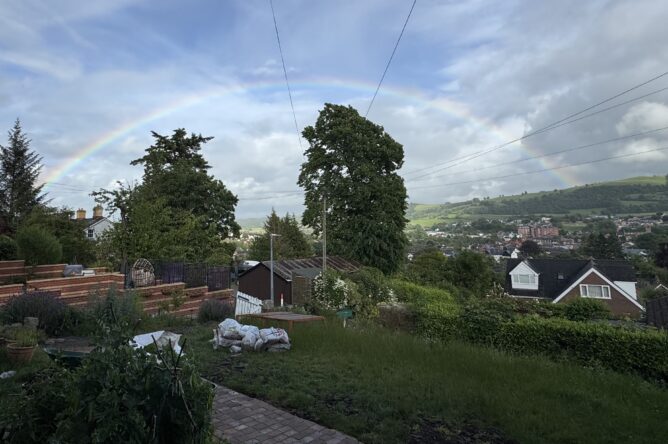
Since Noah died, there have been an astonishing number of rainbows visible from our front garden, often spectacular ones. In the past this has tended to be a one-a-year possibility, now it’s a nearly weekly occurrence.
We’ve taken to embracing these as signs of Noah’s presence and a message of love and affection. There are other little things as well, often bubbling up in our everyday, which we take as little signs and comforts. But then sometimes we also wonder, are we deluding ourselves? Is this just confabulation?
Perhaps a bit unusually for a theologian, I have a large cohort of atheist, non-religious, pagan, and non-theist colleagues and friends. I have observed a shift over the years in this group away from fairly stark commitments to materialism, towards a recognition that the presence and passage of energy and life in our Universe is so complex that it might be considered paradoxical. If anything, it has been those friends who have pressed me to wonder more fiercely about the paradoxical presence of persons – human and non-human.
So in my present moments I hold open a curiosity which I try not to veer into desparation…. wondering and seeking the traces of those special persons who are gone, especially my Noah.