Cross-posted on Wondering Fair

“Beauty is truth, truth beauty,” wrote John Keats in 1819. This celebrated line, still admired as poetry, rings somewhat untrue today. In an age when beauty is often achieved by untruth – Photoshop editing, misleading camera angles, manipulated statistics – and when truth is often not beautiful – the world’s hunger, meaningless tragedies – the connection Keats noticed between truth and beauty seems today tenuous at best.

Still, our idea of beauty carries a direct relationship to our ethics. Contemporary eco-philosophers have noticed, for example, that though a person may appreciate the beauty of a mountain range, or of an endangered tiger, this appreciation of beauty does not necessarily lead to a desire for conservation of one’s idea of beauty. If we think of beauty only in terms of our own subjective experience, and not in terms of beauty being embedded in something outside ourselves (i.e. the animal, or flower, or mountain range), the act of preserving beauty turns in on itself. Beauty becomes only subjective. Our primary concern is to sustain our experience of the sublime, not to promote life outside of us.
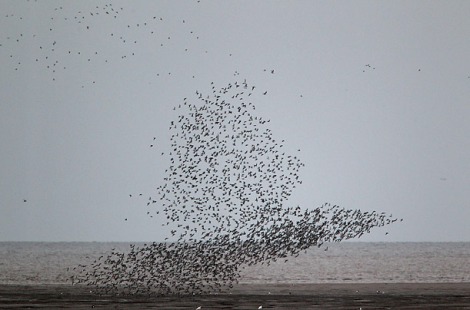
flight-of-fancy

A different perspective arises when we appreciate beauty as something given to us, not arising from inside ourselves. It generates a consideration of beauty which does not get lost in its own subjective sphere, but which also propels us outward, to active engagement in the world. In a dense but interesting comment on a passage by theologian Hans Urs von Balthasar, David Moss observes,

Where we can no longer read the language of beauty so, for Balthasar, the witness of creation as created becomes untrustworthy and open to abuse… In short, those transitory experiences of the truth, goodness and beauty of the cosmos are intelligible only by way of reference to a transcendent order of Being that is absolutely true, good and beautiful.[i]

In other words, only when we recognize objective beauty, truth and goodness in the world, beyond our own subjective experience of it, can we really be moved to preserve it and to admire the work of their creator.

Among the wide variety of theories of beauty competing for our attention (and operating underneath many contemporary cinematic plotlines), one can make a good case for the “wheels coming off” when social understandings of beauty ceased being based on knowledge of a creator God. The celebration of beauty which remains possible within a nihilistic understanding of the world is deeply problematic, and as Moss suggests, open to abuse and even untrustworthy. To affirm God’s act of creation of the world, with all its beauty and ugliness, provides a stability for beauty that allows us to appreciate it in the context of love and relate beauty to truth.

Jeremy Kidwell


[i] David Moss, “Hans Urs Von Balthasar: Beginning with Beauty”, in David Horrell et all., Ecological Hermeneutics (London: T & T Clark, 2010), 202. In case you’re curious, here’s the passage by Hans Urs von Balthasar (a contemporary Swiss theologian) that inspired Moss: “the world, formerly penetrated by God’s light, now becomes but an appearance and a dream – the Romantic vision – and soon thereafter nothing but music. But where the cloud disperses, naked matter remains as an indigestible symbol of fear and anguish. Since nothing else remains, and yet something must be embraced, twentieth-century man is urged to enter this impossible marriage with matter, a union which finally spoils all man’s taste for love. But man cannot bear to live with the object of his impotence, that which remains permanently unmastered. He must either deny or conceal it in the silence of death.” (Balthasar, The Glory of the Lord, Volume I, (1982) 18-19)
As I’ve mentioned in a previous post about my favourite GIS tool QGIS, geospatial software tends to be used in a rather narrow subset of academic research, i.e. mostly environmental scientists and geologists. The reasons for interest there are somewhat obvious, I think, but this is not as much the case for the humanities and social sciences. I was recently having a conversation with a colleague who asked me why maps might be part of my research toolkit and this got me to thinking. There are some good reasons for researchers to be suspicious of cartography – particularly inasmuch as the “gaze” from above can tend to lend a sense of “mastery” and unwarranted epistemological confidence. James C. Scott conveys this powerfully in his book Seeing Like a State.

However, with a bit of humility in hand, geospatial data can be a terrific tool for learning and teaching. Continue reading

Between 2010-2012 I worked with two other colleagues in Divinity to integrate student writing with blogs into one of our courses. We were able to devote some focussed attention to the relative merits and demerits of using blogs in teaching thanks to some funding from the Principal’s Teaching Award Scheme here at the University of Edinburgh (I’d encourage colleagues to apply as it’s a great way to secure resources to explore tech in pedagogical context and PTAS is great about providing avenues for dissemination). If you’d to read a bit more about it, we’ve written up some of our results which were published in 2012 which you can read here. Looking back on the experience of working with this technology in a teaching context over three successive teaching years I have to say that the use of blogging by students is not automatically successful, nor does it necessarily improve the learning experience. An instructor has to be careful about integrating the technology into a learning context which suits its contours as a form of media and a process of content generation. Continue reading

One of my favourite new tools that I’ve added to my social scientific research into environmental activism and religion in Scotland over the past three years has been geospatial work or GIS (short for Geographic Information System). Scholarship in the sociology of religion often works with very large data sets (like censuses), but this work is very seldom parsed out on a geospatial basis. This is a huge loss, I think, as there are a number of important ways that geography inflects demographic data sets. Continue reading

“The Heaven of Animals” by James L. Dickey

Here they are. The soft eyes open.
If they have lived in a wood
It is a wood.
If they have lived on plains
It is grass rolling
Under their feet forever.

Having no souls, they have come,
Anyway, beyond their knowing.
Their instincts wholly bloom
And they rise.
The soft eyes open.

To match them, the landscape flowers,
Outdoing, desperately
Outdoing what is required:
The richest wood,
The deepest field.

For some of these,
It could not be the place
It is, without blood.
These hunt, as they have done,
But with claws and teeth grown perfect,

More deadly than they can believe.
They stalk more silently,
And crouch on the limbs of trees,
And their descent
Upon the bright backs of their prey

May take years
In a sovereign floating of joy.
And those that are hunted
Know this as their life,
Their reward: to walk

Under such trees in full knowledge
Of what is in glory above them,
And to feel no fear,
But acceptance, compliance.
Fulfilling themselves without pain

At the cycle’s center,
They tremble, they walk
Under the tree,
They fall, they are torn,
They rise, they walk again.

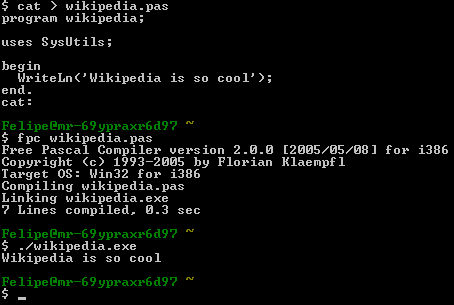
I’ll often be working on my laptop when a colleague walks past, sees a command-line window open with lines scrolling and says something like, “well that looks scary!”. The producers of the matrix captured this sentiment well with their now classic screen image that shows indecipherable characters cascading down a screen.

I think that one of the least appreciated tools might be the command line. Most folks assume that it is the exclusive domain of software engineers (or Matrix insurgents) and miss out on the efficient data manipulation that is just one step away on the command line (or if you write your own code, but we’ll save that for another post!). Continue reading

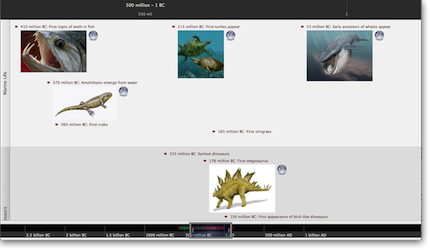
Timelines are an amazingly useful tool. Because my work is so interdisciplinary, I’m always trying to situate my teaching on a particular text or subject within a historical context. Over the years I’ve found that the ability to bang out a quick timeline can really help as a handout for students or a visual for your powerpoint while you’re teaching to quick anchor a subject in its context. As a grant-writer, timelines can also also be a really helpful way of visualising a project, setting milestones, etc.

There are a wide array of timeline-makers that are web-based or make for tablets and smartphones, but having tested about a dozen of these, I’d say that none are really worth the effort. I’ve gravitated towards two desktop software products for different reasons. Continue reading

Cross-posted on Wondering Fair

What does it mean to worship? And where to do it?

For us the activity of worship has become a private affair. Even some agnostics don’t seem to mind that people go about their Sunday mornings engaged in acts of worship, as it occurs comfortably behind closed doors. Occasionally religion spills out into the public space as, in the example of some Christians who fight to keep public monuments of religious significance (the ten commandments, or statues of the cross) in the public space (a courthouse, city center, etc.) in America, or Muslims women who strive to wear the burqa in France. We tend to agree with this relegation of the religious to the private sphere, and often acknowledge it in practice, going about our daily work with only perhaps a furtive prayer or generic expression of virtue, but nothing so peculiar as to strike a secular co-worker as an explicitly religious expression.

burka woman

This division of life into two spheres – public and private – and the further relegation of the religious life to the private sphere has roots in various thinkers and writers across the modern period, but this is a division that is ultimately incompatible from a Christian point of view. Christian worship is, as one theologian (Bernd Wannenwetsch of Oxford University) has recently put it, a Political act: to acknowledge God as the one creator and ruler over everything relativizes every human form of government, and has profound ethical implications in every sphere of life. This fact was perhaps more obvious in the early church as there was a well-worn precedent for “private” religious worship. Rome was relatively tolerant of religious diversity in its empire, provided that worship was relegated to the private space. As long as one’s personal religion remained private, the public space was open for some occasional deference to imperial religion and the state gods which was required for citizenship.

What was remarkable about early Christians is that they refused what was an otherwise comfortable settlement for many other cults of the day. They recognized that the sort of worship that their relationship with the Creator invited them to participate in was wholly encompassing, and as a result, as Wannenwesch puts it, “martyrdom was inevitable, since the ekklesia [church or ‘Christian community’] was bound from the beginning to celebrate ‘political worship’. (148)” Their worship of Jesus blocked their worship of the emperor and the gods, and martyred they were.

There is a sense in which contemporary Christian worship today does not always express the fullness of this reality, but at some point it becomes inevitable. The God we celebrate as being incarnate in the person of Jesus Christ, does not desire a convenient sort of settled relationship, the sort of tepid hug you share with a distant acquaintance. Rather, we are invited into a relationship best represented by a full-on embrace. We are given the gift of life with all its fullness, and this gift is best affirmed by a whole-hearted worship which does not fail to shape all the other dimensions of our lives, private and public. Christian faith transgresses and subverts these boundaries, and invites us away from lifestyles of fragmentation to a daily experience of wholeness.

Jeremy Kidwell

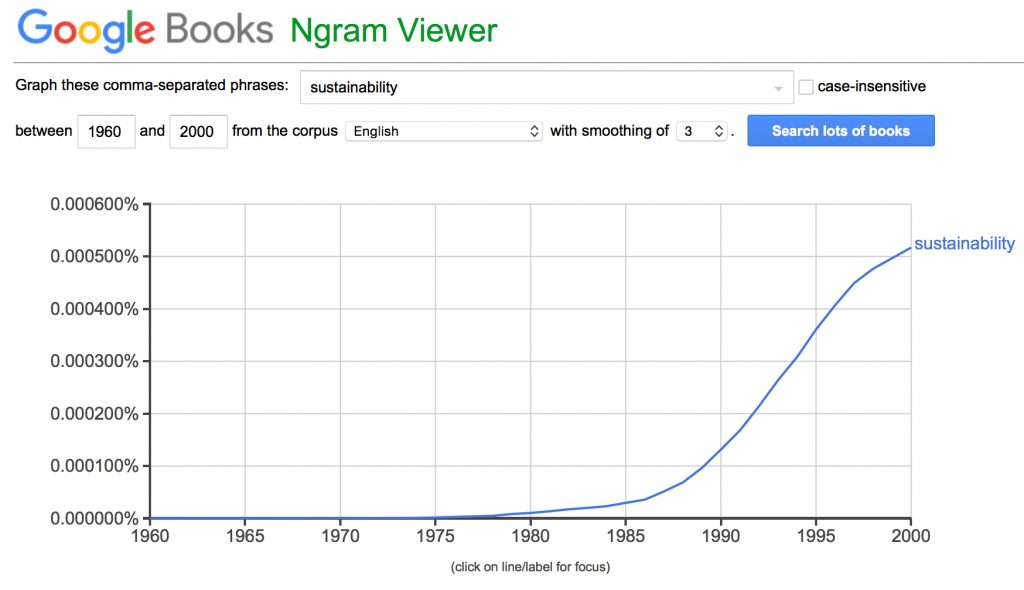
Have you ever had the sense that some term or word which we take for granted might have come into popular use very recently? Or perhaps you wonder if popular usage of some descriptor might have waxed and waned over time? If you’d looking for a quick way to visualise this as data, check out Google’s NGram viewer. If you haven’t already spent time using google books, then I’d recommend you start there. They’ve become a digitizing juggernaut, sometimes in cooperation with University libraries in an effort to create what they describe as “the world’s most comprehensive index of full-text books.” And honestly, they’re probably right.

Having millions of digitized books available is an absolute dream for big data folks such as myself, and Google has been accommodating to people wanting to run research on the database. This can be quite sophisticated, but you can also use NGram viewer for more basic searches. Head on over to the site to check it out for yourself: https://books.google.com/ngrams. There are a few basic functions – you can narrow the search field (which defaults to 1800-2000) and specify the language. You can also run comparative searches on several words, just separate them with commas. Give it a whirl – and let me know in the comments what strange discoveries you make!

I tried a quick search on the much contested term “sustainability” and confirmed that it is indeed a word that no one really bothered using before 1980. There you go.

sustainability

If you want to go really wild, Google makes all their data available through an API. I have in mind to spend some more time working with this tool on my next project which will look at the early (pre-1920) history of environmentalism in Britain and America. Stay tuned for more charts!

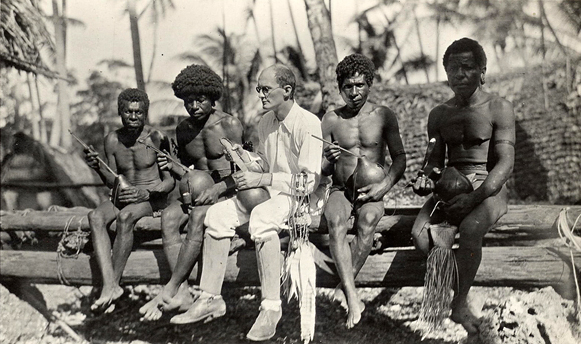
Photo of Bronisław Malinowski, feeling frustrated that the batteries on his smartphone died three months ago.
Bronisław Malinowski feeling frustrated the batteries on his smartphone died three months ago.

Over the past three years, I’ve been moonlighting as a social scientist doing ethnographic fieldwork in communities across Scotland from Callander to Orkney. Before heading out for the first time, I spent a few weeks assembling a toolkit for digital ethnography which I’ve been revising along the way. I thought I’d share a bit about what I’ve settled on using in case others are looking to upgrade their fieldwork toolkit. First, some caveats – I run Apple hardware but am passionate about Free and Open Source Software (FOSS) particularly because it is often cross-platform, so when I switch to linux for my work PC in a couple years, I’ll be able to run most of those tools without much trouble. So my goal was to avoid being proprietary and only go with what was strictly necessary. Here’s what I found: Continue reading